Range sensor plugins for Gazebo, built on the ray tracing sensor simulation library rmagine. With rmagine’s OptiX or Vulkan backends you can simulate depth sensor data directly on a GPU (OptiX requires an RTX card and CUDA; Vulkan runs on any Vulkan-ray-tracing-capable GPU); with the Embree backend you can simulate any provided sensor on the CPU. All backends build an acceleration structure over the scene once and refit it in place as objects move, so simulating dense depth sensors stays fast even in large Gazebo worlds.
Conceptually, two kinds of plugins work together, one pair per backend (Embree/CPU, OptiX/GPU, Vulkan/GPU):
Map plugin syncs rmagine’s scenes with Gazebo’s world, as geometry moves, appears, or disappears.
Sensor plugins use the synced acceleration structure to do raycasting with rmagine’s sensor models: Spherical, Pinhole, O1Dn and OnDn
Currently supported rmagine backends are
embree: Intel Embree-based. Runs smoothly even on low-end hardware
optix: Ultra-fast hardware-accelerated lidar simulation. Requires your system to be compatible with Nvidia CUDA and OptiX
vulkan: Hardware-accelerated lidar simulation on any Vulkan-ray-tracing-capable GPU (not limited to Nvidia/CUDA). No noise model support yet (only OptiX has that currently).
rmagine needs a few common system libraries (TBB, Boost, Eigen, Assimp, CMake); for the OptiX backend, CUDA; for the Vulkan backend, a Vulkan loader/SDK (libvulkan-dev, glslang-tools). If colcon build complains about a missing dependency, see rmagine’s own installation instructions.
Built targets depend on which rmagine components were found:
launch/robot_demo.launch.py spawns a small differential-drive robot
(urdf/example_robot.urdf.xacro) carrying one rmagine Embree spherical
lidar into worlds/gz_embree_robot_demo.sdf (a few static boxes/a cylinder
to drive around and scan), and bridges everything to ROS via
config/ros_gz_bridge_robot_demo.yaml:
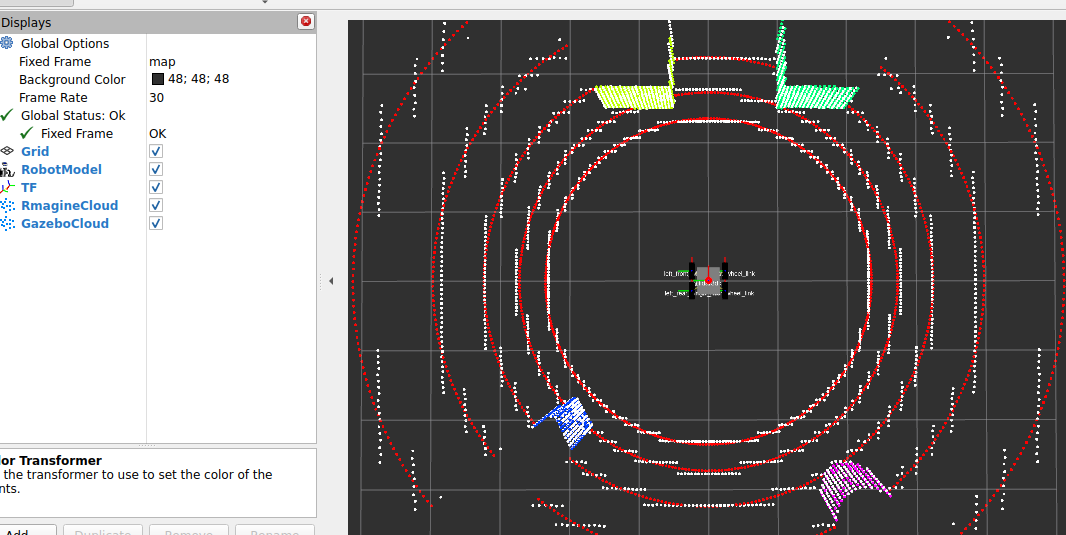
Will launch a Gazebo server and GUI with embree backend enabled (you can switch it to optix or vulkan). Additionally it launches a preconfigured RViz with the standard gpu_lidar (Ogre2) colored in white and the rmagine version colored by object id:
You can drive it with any keyboard teleop of choice. Switch the fixed frame to see how the scans look like with or without localization.
Integration
Once you’ve run the quickstart, these are the building blocks for wiring rmagine sensors into your own world/robot.
Map system (one per world, per backend)
```xml
my_robotmy_robot::lidar_link2000.0010.001false
...
```
`ignore_model`/`ignore_link` exclude a model (or a single link of one, `model::link`) from the raytracing scene entirely; useful for excluding a sensor's own housing, or a robot the sensor is mounted on. `update/rate_limit` caps how often the scene is re-synced (Hz); `delta_trans`/`delta_rot` are the minimum pose change (meters/radians) before a moved entity's transform is pushed into the scene.
Sensor system (one plugin per world, one <sensor> per actual sensor)
```xml
...
default
lidar_link
/model/my_robot/scan/model/my_robot/points20spherical-3.141590.01745360-0.26180.008727600.2100.0
</link>
```
`type="custom"` is required (sdformat validates the standard `type` attribute against its own known sensor type names); `gz:type` is the free-form identifier this package's factory plugin looks for (`rmagine_embree`, `rmagine_optix`, or `rmagine_vulkan`), gz-sim's own documented convention for third-party sensor types, the same one used by its shipped `environmental_sensor.sdf` example.
``/`` are plain gz-transport topic names (this plugin does no automatic `/model//...` namespacing the way gz-sim's built-in sensors do): write the full path you want if you're bridging into a namespaced robot, or a bare name like `scan` if not.
`LaserScan` is only published for a single-ring (`` omitted) Spherical model; a multi-ring 3D scan (or any other model type) publishes `PointCloudPacked` only. Extra output topics can be added with repeated `` elements.
</details>
Bridging to ROS
The published topics use standard `gz.msgs` types, so bridge them to ROS with [`ros_gz_bridge`](https://github.com/gazebosim/ros_gz) like any other Gazebo sensor (see `config/ros_gz_bridge_robot_demo.yaml` for a complete example).
Migrating from gpu_lidar
Switching an existing robot from gz-sim's built-in `gpu_lidar` sensor to rmagine is a same-shape edit to the `` block, not a rewrite. The only thing that never needs to change is your `ros_gz_bridge` config: keep `` set to `/points`, matching `gpu_lidar`'s own convention of auto-publishing `PointCloudPacked` on `/points`, and the same bridge entries that worked for `gpu_lidar` keep working unchanged.
**Before** (`gpu_lidar`):
```xml
scan10lidar_link360-3.141593.1415916-0.2617990.2617990.230.0
```
**After** (rmagine):
```xml
scanscan/points10
lidar_link
-3.141590.0175019360-0.2617990.0349065160.230.0
```
Everything else (``, ``, ``, Pinhole/O1Dn/OnDn-specific tags, ``) is a rmagine-only addition with no `gpu_lidar` equivalent, and all of it is optional.
</details>
Non-spherical sensor models
Set `` to `pinhole`, `o1dn`, or `ondn` (default `spherical`). Every model type follows the same shape as Spherical's `` above: a type-named wrapper containing a `` (how that model scans) and a `/</range>`.
**Pinhole** (depth camera-style):
```xml
pinhole6404801.04720.2100.0
```
**O1Dn** (one shared ray origin, arbitrary ray directions), reads its rays from a `` YAML file:
```yaml
width: 8
height: 4
rays:
orig: [0, 0, 0]
dirs:
- [1, 0, 0]
- [0.99, 0.01, 0]
# ... width * height entries, row-major
```
```xml
o1dn/path/to/rays.yaml0.2100.0
```
...or inline, for small hand-authored ray sets that don't warrant a separate file (same `orig`/`dirs` shape as the YAML, just as nested SDF elements, one `` per ray):
```xml
210 0 01 0 00.99 0.01 00.2100.0
```
**OnDn** (arbitrary ray origins and directions), same ``-or-inline choice, with a per-ray `origs` list instead of a single shared `orig`:
```yaml
width: 8
height: 4
rays:
origs:
- [0, 0, 0]
- [0, 0, 0]
dirs:
- [1, 0, 0]
- [0.99, 0.01, 0]
# ... width * height entries, row-major
```
```xml
ondn/path/to/rays.yaml0.2100.0
```
```xml
210 0 00 0 01 0 00.99 0.01 00.2100.0
```
</details>
Noise (OptiX/GPU sensor system only -- not yet available on Vulkan)
Repeatable `` elements, applied in order to the simulated ranges (in VRAM, before download):
```xml
gaussian0.00.01rel_gaussian0.0021.0uniform_dust0.00000010.5
```
</details>
## Architecture
Two plugin roles per backend, mirroring the classic split between a scene-sync world plugin and a raycasting sensor plugin (gz-sim only has one plugin base type, `System`, so both are `System` plugins, but the responsibilities stay separate):
- **Map system** (`rmagine_embree_map_system` / `rmagine_optix_map_system` / `rmagine_vulkan_map_system`, attached to ``): builds and incrementally maintains one persistent Embree/OptiX/Vulkan scene from the world's `` geometry. Publishes the current map through an in-process registry keyed by `map_key` (default `"default"`). Adding/removing geometry triggers a full acceleration-structure rebuild; moving already-tracked geometry refits the existing one in place instead (all three backends).
- **Sensor system** (`rmagine_embree_sensor_system` / `rmagine_optix_sensor_system` / `rmagine_vulkan_sensor_system`, attached once per ``, like the map system): auto-discovers every `` anywhere in the world via gz-sim's `components::CustomSensor` (the closest available analogue to Gazebo Classic's `GZ_REGISTER_STATIC_SENSOR`; gz-sensors' own plugin-loading mechanism for custom sensor types was removed upstream). For each discovered sensor it looks up the map by `map_key`, raycasts against it (Spherical/Pinhole/O1Dn/OnDn models), and publishes `gz.msgs.LaserScan` (Spherical, single-ring only) and `gz.msgs.PointCloudPacked` over plain **gz-transport**; all sensors of one backend share a single `gz::transport::Node` owned by the factory system.
This plugins are ROS-agnostic (map and sensor systems alike). If you want the data in ROS, bridge it with [`ros_gz_bridge`](https://github.com/gazebosim/ros_gz), see [Bridging to ROS](#usage) above. TF isn't published by this plugin either: attach gz-sim's own `gz::sim::systems::PosePublisher` to your robot and bridge its `gz.msgs.Pose_V` output to `tf2_msgs/msg/TFMessage`, exactly as shown in the quickstart.
## Citation
This package is a Gazebo front-end for [rmagine](https://github.com/uos/rmagine). Please reference the following paper when using it in your scientific work:
```bib
@inproceedings{mock2023rmagine,
title = {Rmagine: 3D Range Sensor Simulation in Polygonal Maps via Ray Tracing for Embedded Hardware on Mobile Robots},
author = {Mock, Alexander and Wiemann, Thomas and Hertzberg, Joachim},
booktitle = {IEEE International Conference on Robotics and Automation (ICRA)},
year = {2023},
doi = {10.1109/ICRA48891.2023.10161388}
}
```
The paper is available on [IEEE Xplore](https://ieeexplore.ieee.org/document/10161388) and as a preprint on [arXiv](https://arxiv.org/abs/2209.13397).